
BIOGRAPHY
American (1893-1968)
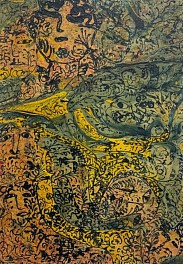
Lawrence Fine Art is pleased to present this important work by pioneering American artist Janet Sobel. Dripping and pouring skeins of paint onto horizontal boards and canvases, Sobel preceded Abstract Expressionist painter Jackson Pollock's better-known use of the technique, and her work challenges existing narratives around mid-century modernism. This work was exhibited at the Menil Collection's 2024 show Janet Sobel: All Over.
In requesting this particular work for the exhibition, the Menil's curator had this to say:
". . . [W]e are requesting only the most accomplished and dynamic works that illuminate Sobel's path toward all-over painting. In this light, Untitled is a singular accomplishment, revealing the range of experimental techniques she developed in the 1940s. Black curlique drips interweave with green, yellow and ochre passages. The arrangement of drips often collect into human faces, making this a particularly beautiful example of Sobel's sophisticated blending of figuration and abstraction."
Sobel's meteoric career began in 1943, when leading dealers, collectors and other artists took up her work. She showed at Peggy Guggenheim's Art of this Century Gallery in 1946. Acclaimed for her skillful use of color and densely layered compositions, she pioneered what became known as "all-over" abstraction, filling her canvases from corner to corner.
Janet Sobel was already a mother of five and a grandmother when she took up painting in her Brighton Beach apartment in 1939. With no prior artistic training, she felt the urge to create and began using one of her sons’ art materials, painting on scraps of paper, the backs of envelopes, pieces of cardboard, and seashells found on the beach. Recognizing his mother’s talent, Sol Sobel introduced her paintings to artists and writers such as Max Ernst, John Dewey, and Sidney Janis, who quickly championed her work. Within just a few years, Sobel had participated in several group exhibitions and was given two solo gallery shows in New York.
In1961, the art critic Clement Greenberg wrote that, in the 1940s, he and Jackson Pollock “had noticed one or two curious paintings…by a ‘primitive’ painter, Janet Sobel.” Greenberg described Sobel’s works as “the first really ‘all-over’ one [he] had ever seen,” adding that “Pollock admitted that these pictures had made an impression on him.”
From then on, Sobel’s practice was mostly framed in relation to Pollock’s career, so that by the time of her death in 1968, she was little more than an anecdote, primarily known as the self-taught “housewife” who happened to have dripped paint on a canvas before Pollock.
Now the artworld knows differently--that Sobel, like many other female painters of the period, were pioneers, just like the men.
Her work is included in, among others, the collections of the American Folk Art Museum (New York), the Hirshhorn Museum and Sculpture Garden (Wash D.C.), the Los Angeles County Museum of Art (Los Angeles), the Museum of Modern Art (New York), and the Whitney Museum of American Art (New York). Sobel’s work was most recently exhibited in “Women in Abstraction” at the Centre Pompidou (2021), “Outliers and American Vanguard Art” at the National Gallery of Art, Washington, DC (2018), and in “Abstract Expressionism” at the Royal Academy of Arts, London (2016), in addition to the Menil exhibition.